return link

Monday, 22 November 2021

Shutter speeds - before and after service

An example of the difference a service can make to the shutter speeds of a camera - in this case, an RTS II.

Shutter speeds before service:


Shutter speeds after service:

And, although not the sole reason for the slow shutter speeds, this is the dirt, on the end of a slip of paper, removed from the shutter magnet which can cause the magnet to be slow in releasing the second curtain and cause the shutter speeds to be slow and, often, more erratic.


Sunday, 8 August 2021

Replacing the 159 focus screen

The 159 focus screen is not considered user replaceable despite it being fairly easy to remove. The problem is refitting it. In the user manual it says the screen should only be replaced at a service centre and with good reason. If not done correctly the screen will, almost certainly, be damaged. I know, I've done it.

I experimented with an old screen to see if I could find a way the screen could be changed without damaging it. Described here is my method found through that experimentation, it's not a manufacturer recommended way.

Before proceeding a method of holding the screen without damaging it is necessary. Later camera models had screens with a tab to be used to hold the screen by but the 159 screen doesn't have a tab. I use a pair of flat tipped tweezers that have had the tips covered in heat shrink cable insulation. This is permanent and I only use them for this purpose but a temporary solution could be some rubber sleeving fitted over the end of some tweezers.


I also recommend the mirror buffer foam be removed. This makes it easy to see the release catch.

First, the camera needs to held inverted.

Contax 159 screen replacement

A piece of card needs to be cut and bent to fit into the camera such that the edge sits against the back of the focus screen frame (see arrow in next picture). The card will stop the frame jumping out of its retaining slot and will also protect the mirror from possible scratching.


Release the screen by pulling back on the catch. The screen frame will pop up. Lift it up and remove the screen from underneath. This is best done by using something with a point to press against the edge of the screen and lift it up then use the covered tweezers to grab the screen and remove it while holding the frame clear. Don't try and remove the frame first, you will probably scratch the screen while trying to remove the frame.

If you do remove the frame after removing the screen, note it has two tabs on it, a wide one on one side and a narrow one on the other, The wide ones goes to the back, the narrow one to the front.


Refitting is the reverse order to the above. Fit the frame first, hold it clear and fit the screen under it. Note the dull (matte) side of the screen goes towards the prism.


Finally, lower the frame but DO NOT try and press down on it to engage it with the latch.

Use a pair of tweezers to pull the latch back as far as it will go. Use the tweezers against the mirror box frame and make sure the latch is held firmly before going further.


This is the most important part of the process. If the latch isn't held back the frame, which is quite flimsy, will get pushed inwards and will scratch the surface of the screen.

With the latch held back, hold the frame into position then release the latch.

This is not an easy procedure to carry out and requires practice of using two pairs of tweezers and a steady hand.

Sunday, 7 February 2021

Yashica FX-3 Super 4000 part II

Following on from my previous post of the same title. The KF-M1 lingered in pieces for a couple of months until I finally decided to convert it to a Contax/Yashica lens mount. I've converted Phenix made, Yashica based, cameras before but from Pentax K mount to C/Y. That was fairly straight forward and I expected this to be the same - I was wrong. Converting from a Nikon mount to a C/Y mount turned out to be more difficult. The main issues were due to the way the Nikon mount transfers aperture information to the body which meant the metering circuit was different and also due to the shorter flange to film distance and the wider lens mount causing some mechanical differences.

Without going into all the details, essentially, I replaced the KF-M1 mirror box and viewfinder along with the meter circuit with the same from a Yashica FX-3. The increased range of shutter speeds is a slight issue and, as it now stands, the meter doesn't work if the 1/4000 shutter speed is selected. That's not really an issue. I also added a grip, replaced the shutter speed knob as the original was difficult to grip, and fitted new covers. As I replaced the viewfinder and metering system with the same from a Yashica FX-3 Super 2000, I also gained a flash ready signal in the viewfinder though that required the hot shoe to be replaced with one with the extra flash contact.

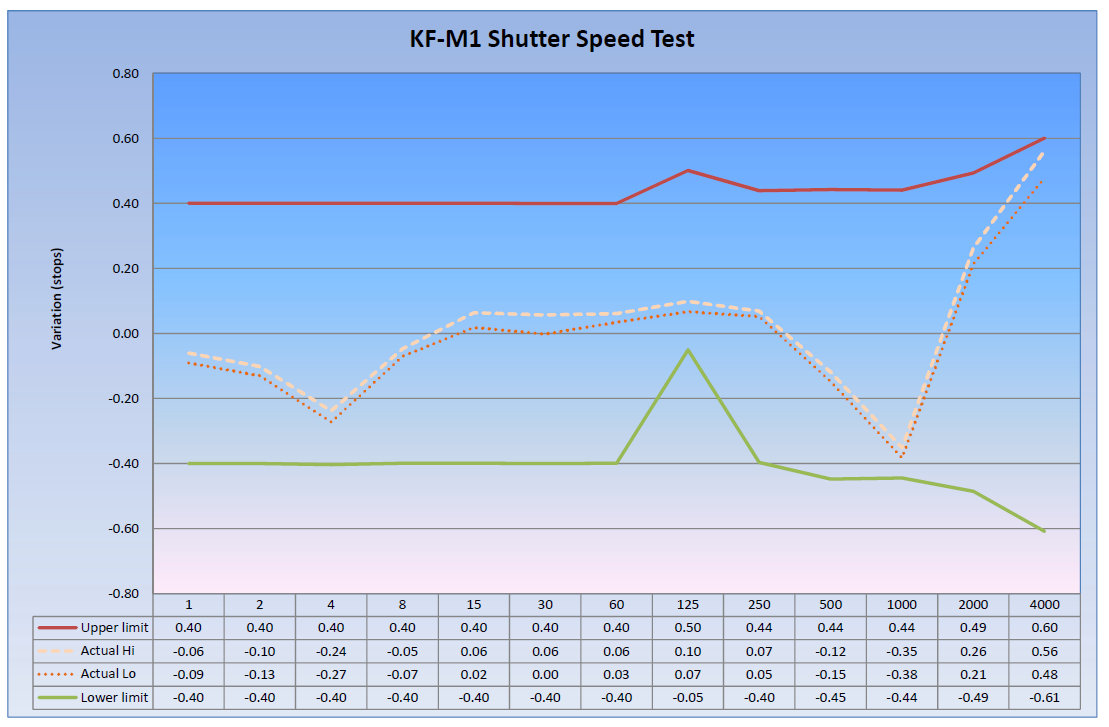
The shutter speeds were adjusted and the 1/4000 is just within specification but it's clear this shutter is struggling to reach the 1/4000 speed. Some further adjustment might improve it but I decided to leave it as it is. 


The same shutter, used in the Yashica Super 2000, but without the 1/4000 speed, exhibits almost identical characteristics and is already struggling to reach 1/2000. This isn't a match for the shutter used in the Contax S2 though, even that, can struggle to reach 1/4000.

Overall, I'm happy with the result. The camera handles well and with the increased weight of the metal top and bottom plates it feels more solid than a Yashica FX-3. Despite the fact I probably won't give it much use, I think it's a keeper.


Update: Despite my reservations about how much use I might give it, this has become a goto camera for me. I really like the handling of it. It's a bit noisy but it's an easy camera to use.


Canon EOS EF Eyecup will fit Contax and Yashica

The Kyocera F-3 eyecup was used on the Contax S2, 167, Aria and maybe other bodies. It also fits earlier bodies like the 139, 137 and 159 and also Yashica bodies like the FX-3, FX-D, FX-103 etc. I, personally, prefer it to the round eyecups that were used on the earlier Contax and Yashicas.

However, the Kyocera F-3 eyecup has become scarce and when they do become available they are expensive. So I looked for an alternative and found the Canon EOS EF eyecup fits perfectly. It's the same style as the Kyocera F-3 though slightly different in shape. Original Canon eyecups are available and are not expensive but there are Chinese made copies that are available very cheaply on ebay.

The Canon EF eyecup fits Canon EOS 350D, 400D, 450D, 500D, 550D, 600D, 1000D etc. bodies. There are other similar models so, if buying, check it's the correct one.

Here's a few pics of one I bought fitted to a FX-3, a 139 and the KF-M1 mentioned in my previous post.


And a couple of pictures of the eyecup itself.


Saturday, 14 November 2020

Yashica FX-3 Super 4000 anyone?

 I recently acquired a Map KF-M1 camera. Made by Phenix in China using a Yashica FX-3 chassis, it has a Nikon lens mount and a top shutter speed of 1/4000 sec. It's the same camera as the Kenko KF-2N which was clearly an attempt to create a camera with the same specification as the Nikon FM-2n. The Map version was made exclusively for Map Camera in Japan and, unusually, has no branding on it. There was another version called the Phenix DN66 sold in the Chinese domestic market.


I was intrigued how the top shutter speed was achieved. The Nikon FM-2n uses the same Copal shutter as the Contax S2 and I knew that shutter will not physically fit into a Yashica FX-3 chassis - I've tried it. The shutter is larger and has slightly different mounting positions. So, to find out how it was done, I had to get a camera. All the variants are rare and, if you do find one, expensive. But I found a KF-M1 in China. The seller accepted an offer but it still cost me nearly £190 with the import tax paid.

With the camera dismantled, first inspection of the shutter suggested it was the same shutter as is fitted to the Yashica Super 2000 (and many other cameras) but it has an extra position on the shutter speed selector. A check of the shutter speeds shows it is struggling to get to 1/4000 and the general shape of the test results graph is very similar to that from a Yashica Super 2000.

(Note: The upper and lower limits on the above results sheet are from a Contax S2 and are not correct for the KF-M1. They should be the same as the FX-3 limits below.)

It's not unusual for the Yashica Super 2000 shutter to be slow at the top speed but some adjustment will usually bring it into specification. I'll have to see if I can get the KF-M1 shutter closer to what it should be.

So it appears Copal produced a further upgrade to the 2000 shutter, which was itself an upgrade of the original 1000 shutter as used in the original FX-3. So I'm surprised that a Yashica Super 4000 never appeared if the shutter was available and could be fitted with no modification to the existing FX-3 chassis. Maybe it was because it would be competing with the Contax S2.

Now I need to decide what to do with the dismantled KF-M1. I don't want a camera with a Nikon lens mount. I could fit the shutter into an existing FX-3 Super 2000 or I could fit a Yashica lens mount to the KF-M1. The camera is quite well made and, unlike the Yashica with plastic top and bottom plates, the KF-M1 has metal top and bottom. The focus screen is the original Yashica one with the diagonal split prism, which I don't like, but if I change the lens mount I'll also have to change the viewfinder so that's not an issue. Whatever I do, the camera is unlikely to get a lot of use from me so if someone out there has an urge to own a Yashica Super 4000, get in touch and we can discuss.

Update: There is now a part 2 to this post at https://contax139.blogspot.com/2021/02/yashica-fx-3-super-4000-part-ii.html

Sunday, 6 September 2020

Contax 50mm f/1.7 AE/MM differences

I've worked on both AE and MM versions of this lens before but have never done a direct comparison of the two. Recently I had reason to work on one of each at the same time so was able to do some direct comparisons of their construction. I thought it was worth recording what I found.

The two samples I compared had serial numbers 6504056 (AE) and 7380543 (MM). The differences noted may not be the same for all AE or all MM lenses.

Plastic/metal

The lens uses metal components for the focusing helical, plastic for the internal block that includes the aperture mechanism and carries the lens elements and a mixture of metal and plastic parts for the focus and aperture controls and front cover and dress ring. This is mostly the same in both lens versions except the focus ring on the MM version is metal but plastic on the AE version. The AE version I had showed why this change was probably made - it had cracks in the plastic around the screws that attach the ring to the focusing mechanism. This had caused the focusing ring to become loose and allowed the focusing helical to separate - which is how I came to have the lens. I have seen some cracks like this before so is clearly a potential issue.


Focus guides

Lenses of this general construction usually have one or more guides that allow the focus helical to move back and forth but stopping it from rotating. If these guides, or the slots they move in, become worn, slop or backlash can appear in the focus mechanism. Many lenses have one of the guides split so that its width can be adjusted to take up any excess. The AE version didn't have a split guide while the MM version did.


The slot in the helical component was also different in cross section which means the guide only contacts the helical at the edges in the MM version. What difference this would make I don't know.


Lens mount

The construction of the lens mount is completely different on these two lenses but I think the mount changed before the MM lenses were introduced so this isn't a AE/MM difference as such. The mount, of course, works in exactly the same way but the parts and their assembly is different.

I guess the question has to be, if the differences are so small, why is one lens suited to MM mode cameras and the other not. There may be other differences between the aperture mechanisms that are not really visible. The small constructional differences I could see between the two assemblies were not worth mentioning but maybe they do have some significance. The basic operation of both look identical.

Edit: I have, of course, passed over the infamous 'ninja star' aperture shape of the AE lenses. This is minimal on the 50/1.7 but it is present and shows the shape of the aperture leaves on the two lenses are different.

Sunday, 2 August 2020

A new 139 fault

There's not many faults on the 139 I haven't previously seen but I did find a new one recently. The camera had very inconsistent shutter speeds with variations of up to half a stop in either direction. The shutter speeds are often out of specification, maybe 50% of the time, but I've never before seen a 139 with such variations.

The problem was caused by a contaminated shutter magnet so the solution was quite simple - clean the magnet. It's something I do anyway if I service a 139.

The shutter magnet is not to be confused with the release magnet, which can also become contaminated but the symptoms are different. Here's a picture of the shutter magnet. The white plastic arm has a metal plate at the top which contacts the magnet face. This plate and the magnet face are the parts that need to be cleaned.


The more usual symptom of a contaminated shutter magnet is the shutter staying open due to the plastic arm staying permanently stuck to the magnet.