return link

Showing posts with label other cameras. Show all posts

Monday, 13 July 2026

 This is a copy of a post I made to Facebook.

YASHICA FX-A

Now here's something you may not have seen before, or ever see again, it's the rarest of Yashica SLRs, the FX-A.

There's not much information around about the FX-A. It was introduced at Photokina in 1982 but the plug was pulled on the project soon after and there was only, allegedly, around 1000 made, most of which, allegedly, were bought by the US Government. I'm not sure any of this can be verified but it's a fact that few were made and they rarely show up for sale.

The FX-A has built-in focus-assist so is a predecessor of the later Contax RX. It is not auto-focus and I, personally, can't see how it could ever have been an auto-focus camera as there are no couplings to the lens that would allow the lens to be controlled by the body. I think this was only ever going to be a focus-assist system, just like the RX. At the same time, Yashica were developing a AF version of the Contax 137 which may have been a full auto-focus system - we'll never know.

The FX-A has been described as similar to the FX-D. In fact it has very little similarity to the FX-D and it would be misleading to say it is. It is a generation later than the FX-D and the style and build are much more similar to the FX-70 and the FX-103. Both of these cameras came later so it seems some of the development of the FX-A did not go unused and appeared in these later cameras. The shutter, particularly, is different than the FX-D or any earlier cameras but the same shutter was carried over into the FX-70 and FX-103. Other parts and assemblies also got reused in the later cameras.

If I am being perfectly honest, the FX-A, along with the FX-70 and FX-103, are not built as well as the FX-D. Maybe this was the result of cost cutting measures, perhaps due to Yashica's financial woes of the time prior to the Kyocera take-over.

It seems the camera was intended to have a number of accessories including a winder and a data (or date) back. There are four winder contacts on the base suggesting the winder would be based on the Contax 159 winder which also has four contacts. But one of the contacts on the FX-A is not connected so it would have had less functionality. The Contax 139 winder fits and works as intended. The later FX-103 also had four contacts and a winder which looks identical to the Contax 139 winder so this was probably what was intended for the FX-A. The 139 winder only needs two contacts though so I don't know why they included more.

The camera has a data back LED to trigger the data back each time the shutter is released. So a data back was planned. This eventually appeared with the FX-103.

Other functions include a flash ready contact in the hot shoe. This works with the Contax TLA20 but I've not checked it with any other flash models. There is no TTL flash. This was introduced with the FX-103.

There is also a self timer switch on the front of the camera which also provides a momentary exposure lock.

There is one thing about the camera I have failed to understand. At the top of the lens mount is a switch which is activated by the lens maximum aperture tab. Normally this tab tells the body the maximum aperture of the lens which it uses for displaying the aperture in use. But the FX-A doesn't display the aperture and, what's more, this is just a switch, not a variable resistance or a digital encoder as is found on other bodies to indicate the aperture. So what this switch was intended for I don't know. It just seems to tell the body that a lens has been attached and no more.

My example of the FX-A appeared recently on ebay. I was lucky. It had only just been put on when I saw it. The buy-it-now button has never been pressed so fast. There was no information other than it was untested so I expected it not to work. But on inspection it powered-up and the lights came on, including the focus indicators, but the shutter wouldn't fire. I also noted the mirror had slipped. Two common problems with Yashica SLRs. Having fixed these problems many times in the past on other Yashica (and Contax) models, I had no hesitation to attempt repairing the camera albeit knowing there would be some differences. The main difference, of course, is the additional modules and circuitry for the focus assist. This has caused the flexible circuit board to be enlarged and increased in complexity which makes removal, required to enable the camera to be dismantled, somewhat more complex and time consuming. Overall I spent nearly two days repairing and servicing the camera. The camera now works as intended and has also had a full service carried out.

The leatherette covers on the camera were perished as usually happens. Strangely, the cover around the grip is rubber and was in perfect order. I've replaced the other covers with some I had and have fitted a rubber thumb grip to the back which I think compliments the front grip quite well.

The focus-assist works well in good light with a contrasty subject. But it becomes less reliable as brightness and contrast reduces. There are no other focus aids in the viewfinder so you either rely on the focus assist or use the matt area of the screen to focus.

The FX-A is now a collectors item. I don't see this as a users camera. It's quirky and interesting to use (once) but will then sit on the shelf I'm sure. I'm not really a collector so if anyone is interested in becoming the owner of this FX-A, make me an offer. It will have to be a good one though.

I've attached a selection of photos taken during the repair for anyone interested in the internals.


Sunday, 7 February 2021

Yashica FX-3 Super 4000 part II

Following on from my previous post of the same title. The KF-M1 lingered in pieces for a couple of months until I finally decided to convert it to a Contax/Yashica lens mount. I've converted Phenix made, Yashica based, cameras before but from Pentax K mount to C/Y. That was fairly straight forward and I expected this to be the same - I was wrong. Converting from a Nikon mount to a C/Y mount turned out to be more difficult. The main issues were due to the way the Nikon mount transfers aperture information to the body which meant the metering circuit was different and also due to the shorter flange to film distance and the wider lens mount causing some mechanical differences.

Without going into all the details, essentially, I replaced the KF-M1 mirror box and viewfinder along with the meter circuit with the same from a Yashica FX-3. The increased range of shutter speeds is a slight issue and, as it now stands, the meter doesn't work if the 1/4000 shutter speed is selected. That's not really an issue. I also added a grip, replaced the shutter speed knob as the original was difficult to grip, and fitted new covers. As I replaced the viewfinder and metering system with the same from a Yashica FX-3 Super 2000, I also gained a flash ready signal in the viewfinder though that required the hot shoe to be replaced with one with the extra flash contact.

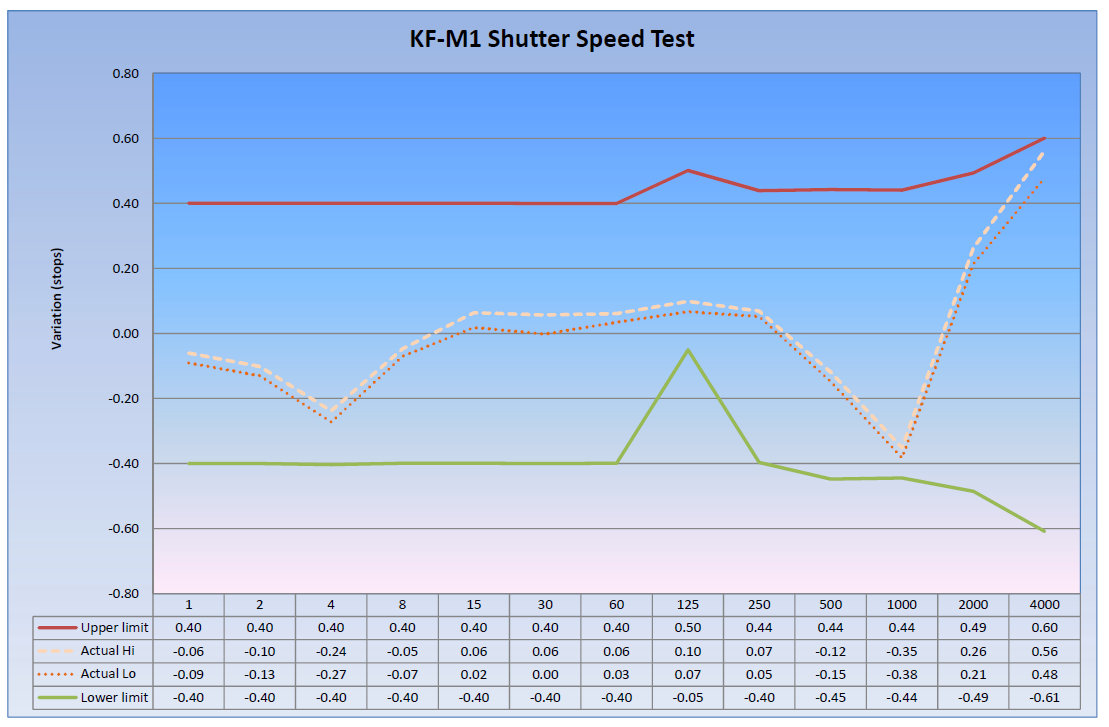
The shutter speeds were adjusted and the 1/4000 is just within specification but it's clear this shutter is struggling to reach the 1/4000 speed. Some further adjustment might improve it but I decided to leave it as it is. 


The same shutter, used in the Yashica Super 2000, but without the 1/4000 speed, exhibits almost identical characteristics and is already struggling to reach 1/2000. This isn't a match for the shutter used in the Contax S2 though, even that, can struggle to reach 1/4000.

Overall, I'm happy with the result. The camera handles well and with the increased weight of the metal top and bottom plates it feels more solid than a Yashica FX-3. Despite the fact I probably won't give it much use, I think it's a keeper.


Update: Despite my reservations about how much use I might give it, this has become a goto camera for me. I really like the handling of it. It's a bit noisy but it's an easy camera to use.


Saturday, 14 November 2020

Yashica FX-3 Super 4000 anyone?

 I recently acquired a Map KF-M1 camera. Made by Phenix in China using a Yashica FX-3 chassis, it has a Nikon lens mount and a top shutter speed of 1/4000 sec. It's the same camera as the Kenko KF-2N which was clearly an attempt to create a camera with the same specification as the Nikon FM-2n. The Map version was made exclusively for Map Camera in Japan and, unusually, has no branding on it. There was another version called the Phenix DN66 sold in the Chinese domestic market.


I was intrigued how the top shutter speed was achieved. The Nikon FM-2n uses the same Copal shutter as the Contax S2 and I knew that shutter will not physically fit into a Yashica FX-3 chassis - I've tried it. The shutter is larger and has slightly different mounting positions. So, to find out how it was done, I had to get a camera. All the variants are rare and, if you do find one, expensive. But I found a KF-M1 in China. The seller accepted an offer but it still cost me nearly £190 with the import tax paid.

With the camera dismantled, first inspection of the shutter suggested it was the same shutter as is fitted to the Yashica Super 2000 (and many other cameras) but it has an extra position on the shutter speed selector. A check of the shutter speeds shows it is struggling to get to 1/4000 and the general shape of the test results graph is very similar to that from a Yashica Super 2000.

(Note: The upper and lower limits on the above results sheet are from a Contax S2 and are not correct for the KF-M1. They should be the same as the FX-3 limits below.)

It's not unusual for the Yashica Super 2000 shutter to be slow at the top speed but some adjustment will usually bring it into specification. I'll have to see if I can get the KF-M1 shutter closer to what it should be.

So it appears Copal produced a further upgrade to the 2000 shutter, which was itself an upgrade of the original 1000 shutter as used in the original FX-3. So I'm surprised that a Yashica Super 4000 never appeared if the shutter was available and could be fitted with no modification to the existing FX-3 chassis. Maybe it was because it would be competing with the Contax S2.

Now I need to decide what to do with the dismantled KF-M1. I don't want a camera with a Nikon lens mount. I could fit the shutter into an existing FX-3 Super 2000 or I could fit a Yashica lens mount to the KF-M1. The camera is quite well made and, unlike the Yashica with plastic top and bottom plates, the KF-M1 has metal top and bottom. The focus screen is the original Yashica one with the diagonal split prism, which I don't like, but if I change the lens mount I'll also have to change the viewfinder so that's not an issue. Whatever I do, the camera is unlikely to get a lot of use from me so if someone out there has an urge to own a Yashica Super 4000, get in touch and we can discuss.

Update: There is now a part 2 to this post at https://contax139.blogspot.com/2021/02/yashica-fx-3-super-4000-part-ii.html

Saturday, 4 July 2020

Yasuhara T981

I've created a new website for the above camera. Nothing Contax related but there is some Yashica interest. You can find it at www.t981.co.uk https://sites.google.com/site/t981yasuhara/home.


Sunday, 21 April 2019

FX-3 Super 2000 - spot the difference

Can you spot three differences between these bodies? (click on the images for larger versions).


So what's the difference and why.

The top one is the earlier version of the FX-3 Super 2000 (I call it the mk1), the bottom one is the later version (mk2). The visible differences are the strap lugs, the badge and the finish on the grip - the mk2 has a moulded finish to the grip while the mk1 has a stick on, leatherette, cover that matches the other covers.

There are a few internal differences as well but they are pretty insignificant. A few changes to the cover mouldings to reduce the part count mainly. I did replace the shutter in the top one of the two examples shown and found a slight difference between the one fitted and the spare one I had which may have come from a later camera. But it only required the swap of one gear to make it compatible.

I don't know why these changes were made. The later one appears slightly simpler in construction so it may have been a cost saving exercise to make assembly easier and quicker.

Anyone looking to buy an FX-3 shouldn't have any concern about the differences - they make no difference to the function or the reliability of the camera.

Note: In calling these two versions 'earlier' and 'later' or 'mk1' and 'mk2' I'm making assumptions about their age. I might be wrong. It's possible what I consider to be the later one might be the earlier one. But as the mk1 is more similar to the earlier versions of the FX-3 I'm assuming that one came first. It's also possible they were made in parallel but in different factories. If anyone has any information, I would be interested to see it.

Saturday, 29 April 2017

Phenix variants

NOTE: Since writing this I have completely changed my view on who made these FX-3 variants. They were, I'm now sure, made by Phenix in China and not Cosina. In fact, there is no evidence, that I've ever seen, to support the theory that Cosina made FX-3 cameras at any time. There is plenty of evidence that Phenix did though.

I've been doing a bit of research into what other cameras, made by Cosina Phenix, were based on the same chassis as the FX-3 and, therefore, may share other parts and be useful as donors. Or perhaps may be alternatives to buy and use. What I have found is there were a number of similar cameras and quite a few were made with the Pentax K mount - the previously mentioned Centon K100 being one and others sold under the brands of Vivitar, Braun, Hikari, Promaster, Kenko, Phenix and probably a few more. (Note: not all cameras sold under these brand names were based on the same chassis). Some of these were also available with Nikon or Minolta MD lens mounts. Most are mechanical cameras using the same Copal shutter as the Yashica FX-3 or FX-3 Super 2000 though a few, including the Centon K100, seem to use an electronic Seiko shutter.

I recently acquired a Vivitar V3000 and a V3800N which are all but identical to a Yashica Super 2000 except they have a PK mount. The V3800N was given a face lift and uses a rear door straight off the Centon K100 complete with the rubber covers.

So there are many models that came from Cosina Phenix that share parts and features. All are quite basic and mostly very usable. With a choice of lens mounts available these are cheap ways of maybe trying out a lens without committing to a full system.

As a, sort of, proof of the compatibility of these cameras, I took three cameras I had, all of which had issues and none of which were really worth repairing in their own right, and built one camera from the three. Most of the operational parts (shutter, metering system and viewfinder) came from a Yashica FX-3 Super 2000 but the chassis of the camera was in poor condition with a lot of paint loss so I used a chassis from an original FX-3 and transferred the parts to that. I kept the original FX-3 film advance mechanism in the chassis. I then fitted top and bottom plates, rear door and rubber covers from a Centon K100. Here's the result fitted with a Contax 45mm f/2.8 pancake lens and custom made hood.


I removed the Centon name and model from the top plate as that's not what the camera is. 

I'm now thinking of doing a similar thing with a PK mount body as there's a few Pentax SMC lenses I've wanted to try.


Sunday, 22 January 2017

In praise of the FX-3

Further information and experience has resulted in an update to this post which has been added at the the end.

The Yashica FX-3 was originally introduced in 1979 and cost, body only, less than £70 in the UK or around £100 with a lens. Clearly aimed at the budget conscious buyer but it proved popular with others who recognised its simple benefits. I bought my first one in the early eighties as a backup to my Contax 139 and to carry with me on the many overseas trips I used to do at the time, often to countries where buying batteries for a modern camera would have been impossible, let alone getting one repaired. The FX-3, being entirely mechanical and battery independant, made an ideal backup and I'm sure many were sold just for that reason.

The FX-3 is as basic as an SLR can be and that is surely one of its attractions. It has all you need to take photographs with nothing extra thrown in. The viewfinder is better than many, the meter is basic, the film advance works and the shutter does its job. And there's a wide range of lenses that can be used with it sold under the Yashica and Zeiss brands.

There's lots of information around the Web describing the FX-3 and there's no point in me repeating the same information here. But, having repaired FX-3s, I probably have a slightly different viewpoint than others.

The FX-3 is built on an almost identical chassis to the Contax 139 and shares some parts with it, particularly in the film advance mechanism and the mirror box assembly. The shutter is, of course, different but, even that, has some similarity to the Contax one and some shared parts. The shutters in both cameras are mechanically (spring) driven but the Contax one is timed electronically while the FX-3 is fully mechanical. Generally, mechanical shutters are not so accurate and this is the case with the FX-3 and, I have found, they can be significantly out if not maintained. But that can happen to electronically timed shutters as well, especially at the higher speeds where the mechanics of the shutter can have a larger effect if not operating correctly.

The shutter is made by Copal and is one of their many variants of the 'square' shutter. The same shutter was used in many entry level SLRs, especially ones built by Cosina as was the FX-3. In common with the FX-3, many of these cameras had an upgrade version released with the top shutter speed raised from 1/1000 to 1/2000 once the shutter was capable of achieving it (for example the Cosina CT-1 becoming the CT-1 Super). Exactly what was changed between the 1/1000 version shutter and the 1/2000 version I don't know as they look identical and the 1/1000 version has a position for the 1/2000 shutter speed though it's not click stopped. The same shutter went on to be developed further to achieve a 1/4000 top speed and was used in the Nikon FM2 and the Contax S2. In my experience, all these variants of the shutter struggle to reach their maximum quoted speed. A review of the FX-3 in a 1980 magazine noted "the top speeds were slow and the slow speeds were fast" which is a clear indication the shutter is struggling at the higher speeds. That said, when working correctly the speeds should be close enough to not cause issues.

One annoying (to me anyway) feature of the FX-3 which it shares with the Contax S2, is the noise it makes. There is a distinctive 'ring' which continues after the shutter has been released. It's caused by some springs in the mirror mechanism that continue to ring after the mirror returns to its normal position. It's an easy fix to damp the springs and give the camera a more positive sound. In the Contax 139, which has the same mechanism, the mirror is damped so the camera doesn't suffer the same problem but, in the FX-3 and also the S2, the mechanical shutter takes up the space where the mirror damper sits in the 139 so it couldn't be fitted.

The FX-3 was initially upgraded in 1984 to become the FX-3 Super (which, confusingly when compared to other upgraded models that used the 'Super' label, did not have the upgraded shutter). The Super variant had a grip added, the meter switch was moved from the back of the camera to the shutter release and an extra contact was added to the hot shoe to enable a flash ready signal to be added to the viewfinder. It wasn't until 1986 that the Super 2000 variant was released with the 1/2000 top shutter speed. The Super 2000 also had a recalibrated meter circuit that shifted the ISO range up by one stop.

The FX-3 is often compared to other similar cameras, especially the Cosina made ones, but often the comparisons are incorrect. Some confusion is caused by the range of budget cameras made by Cosina for other manufacturers which were based on its CT-1 chassis. Although the specifications may be similar, the chassis is different and, in my view, the CT-1 chassis is not as stable - especially the
way the prism/viewfinder is mounted which could cause focus errors. The FX-3 (Contax 139) chassis was used in other cameras made by Cosina, such as the Centon K100 and it seems to have found its way to
some Chinese manufacturers (maybe via Cosina using Chinese factories to assemble cameras) as it appears as a Huaxia DC-1 and a couple of Phenix models and maybe others. Of all these, I would rate the FX-3 as the best, especially considering how cheaply it can be bought these days. Although I also like the Centon K100 which has an electronically controlled shutter (though the one I have has inaccurate shutter speeds).

If you're looking for a user manual for the FX-3 you can download one from that nice Mr Butkus at http://www.cameramanuals.org/yashica_pdf/yashica_fx-3_short.pdf. If you are looking for a service manual, it can be downloaded from my Documents page at the main Contax 139 site.

Update: When writing this post I was under the impression that Cosina had some input on these cameras. My opinion now is Cosina had nothing to do with any Yashica cameras or the many variants made based on the Yashica design. All these cameras were made by Phenix in China.

The shutter used in the Contax S2 and the Nikon FM2n is of the same design as that used in the FX-3 but I couldn't say it's a direct development of the FX-3 shutter. In fact, the FX-3 shutter was further developed to include a top speed of 1/4000 but it wasn't used in the S2. It was used in the Kenko KF-2N and it's clones - the KF-M1 and the DN-66, all made by Phenix.

Sunday, 15 January 2017

S2 fixed

Finally got the S2 shutter sorted and the camera rebuilt. Besides the shutter issues, the mirror had slipped and required removing and refitting, the focus screen was scratched and needed replacing, someone had glued an eyepiece to the camera that had to be removed and the glue cleaned off, the meter was dead and the seals needed replacing. All now done so I just need to load a film and start using it.


Thursday, 29 December 2016

S2 Problems

I bought an S2 a few weeks ago from a dealer in Japan who described it as good condition but with a faulty meter. The fault meant it was a fair, though not necessarily cheap, price. I bought it with the view of fixing it and keeping it. On receipt, though, it was obvious there were several other problems with it. A few emails back and forth and the seller agreed my, much reduced, valuation of the camera and gave me a partial refund.

One of the problems was massively slow top shutter speeds. To do anything with the shutter usually means removing it and that means an almost total dismantle of the camera. Here's the camera now.


The shutter (top middle) is not intended to be repaired or adjusted. The manual says shutters come pre-adjusted and gives no information on how to adjust them. I've worked on these shutters before and have discovered the general principles of how to adjust them but the process is more art than science and this one is not cooperating. I might have to find a replacement.

Here's the shutter back in the camera for testing after one of my many attempts to get all the speeds to within specification.


I'll post further news of this adventure in camera repair as it happens.